

Service business owner burnout doesn’t start on the job site. It starts at 3am. Here’s what actually broke the cycle.
You know the ritual. Lights off by ten, body exhausted, brain accelerating. Every service business owner knows this version of the night, the one where the day you just lived replays itself against the ceiling while tomorrow's version starts assembling in parallel, and somewhere between what you should have done and what you swear you're going to do, sleep becomes a negotiation you keep losing.
I called it doom planning. Everyone knows doom scrolling, that mindless late-night consumption of content that leaves you emptier than when you started. Doom planning is the ambitious version. You're lying in bed constructing the entire architecture of your better life, mapping out your real priorities, interrogating your values, dissecting every decision that got you to this exact moment and sorting them into two piles: what helped and what you need to make sure never happens again.
It feels productive. That's the trap.
Why Service Business Owner Burnout Doesn’t Look Like Burnout
Service business owner burnout rarely looks like collapse. It looks like competence stretched so thin that functioning during the day requires unraveling at night, like sleep becoming a recurring negotiation you keep losing because your brain refuses to accept that the day is actually over. The cognitive overload of switching between technician, estimator, project manager, and firefighter every single hour creates a nervous system that never fully powers down, an operating state where the machinery of your business runs constantly in the background of your mind because every critical decision still routes through you. You're not weak. You're carrying a business architecture that was never designed to let you rest.
So the doom planning continues, except now it's wearing a mask of ambition.
By midnight the plans have plans. You've restructured your schedule, reimagined your morning routine, committed to the discipline you've been avoiding. You can see the version of yourself who executes all of this and he looks confident, rested, in control of something. By two in the morning the planning has curdled into something else entirely. The change order you never documented. The proposal that sat on your desk three days too long while the homeowner called someone else. The crew mistakes that cascaded from your own failure to build proper documentation during pre-construction, mistakes you knew were yours even when you pointed the finger elsewhere. Every error you ever absorbed is now circling in formation, and the self-doubt that was hiding behind all that ambitious planning has finally stepped into the open.
How can you trust yourself to execute what needs to be done when the evidence of your own patterns keeps mounting?
If you're lucky, you've exhausted yourself by four and you can steal a couple hours of unconsciousness before the alarm drags you back. Most nights I wasn't lucky. Most nights I found myself standing in the kitchen making a pot of coffee at a time when reasonable people were still three hours from waking up, then walking straight to my desk to execute on all those beautiful plans, running on fumes, less sharp and less focused and less productive than the version of me who actually slept, compounding the exact problem I spent all night trying to solve. There's plenty of research confirming what you already feel that sleep deprivation degrades the exact cognitive functions we need most when running a business: decision-making, emotional regulation, and the ability to distinguish real problems from imagined ones.
This went on for years.
The Night It Broke
The night it finally broke me was unremarkable by any dramatic standard. I was closing out a big project, wrapping up the kind of details that multiply the closer you look at them. We were leaving for a family vacation the next morning, something my wife and kids had been looking forward to for weeks, and I was sitting with the suffocating certainty that I'd spend half the trip on the phone putting out fires while they got the version of me they'd been getting most days. The unpresent, stressed, exhausted existence that the whole trip was supposed to be relieving. If you've ever felt this, you know what it is. It's the owner-operator trap, and it will consume every good thing in your life if you let it.
 Image
Image
Something had to give.
So I made a decision that terrified me. I got my team in position to handle what they could, and I shut my phone off. Logged out of email. Let whatever was going to happen, happen. I was not going to put myself through another vacation where my family got the worst half of me, where the decompression I desperately needed got sabotaged by my own inability to release the grip.
The first few nights were brutal. I lay awake at three in the morning on a vacation wondering how many nails I was pounding into my livelihood's coffin. Every unanswered call was a catastrophe I couldn't see. Every email I wasn't reading was a fire spreading unchecked.
Then after a day or so, it stopped.
The rumination, the worry, the self-doubt, all of it lifted away once I finally allowed myself some separation. Once I started to see myself as an actual human being detached from my business rather than a life support system keeping it breathing.
What Clarity Actually Looks Like
And then came the clarity. All at once, like a rush of water through a dam I'd spent years building out of my own sabotage. The fractured attention that had been splintering every plan I made, every system I tried to implement, every good idea I had at two in the morning and couldn't execute by noon, it all connected. The planning I'd been doing for weeks suddenly had somewhere to land because my mind was finally still enough to receive it.
The legacy advice still held true, and that's where I started. SOPs. Structured processes. Knowing my numbers. Simple clarity into the functions that had always seemed like some voodoo ritual where decisions get made by chopping off a chicken head and seeing where the body lands (thanks, South Park). The fundamentals weren't revolutionary, but they'd been invisible to me through the fog of exhaustion and fractured focus for years.
With that foundation in place I knew I needed to build upon it. Like most business owners I'd been using AI for a couple years at that point, mostly ChatGPT, and I never really jumped on the prompt engineering bandwagon, searching out these elaborate and impressive prompts that promised the "best" results. Which is mostly bullshit, by the way. I just treated the LLM like a person and had conversations with it where I provided the context, the instructions, the behavior I expected, the results I needed. And it was genuinely helpful in getting me up to speed on everything I'd fallen behind on far quicker than I could have managed alone.
But I knew there was more. I knew there had to be something beyond using AI as a faster search engine, some way to layer intelligence on top of the operational chaos that had been consuming me for eight years, something that would fundamentally change how the work got done rather than just helping me do the same broken work slightly faster. This is where most AI implementations go wrong, by the way. They speed up broken processes instead of fixing the underlying structure.
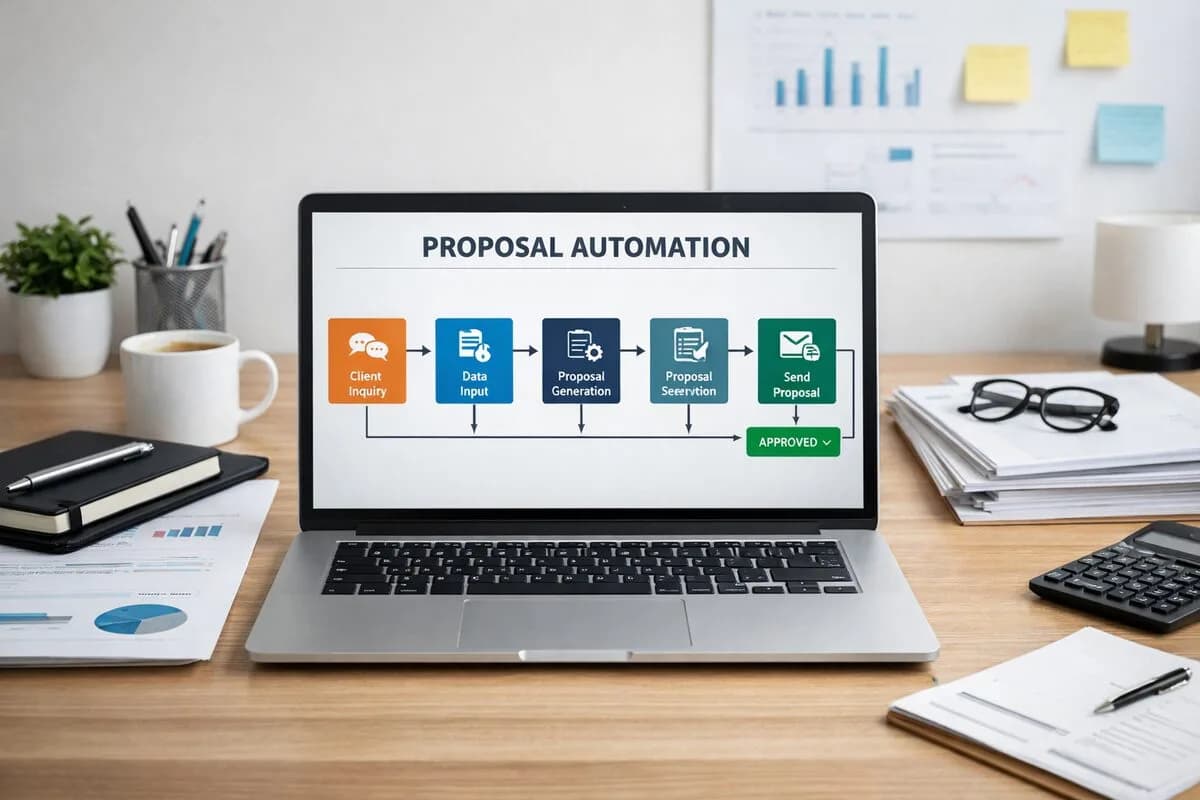
When I finished the first version of my proposal automation system, the feeling was simple elation. Even in its most basic form it was saving me hours per proposal. Hours I used to spend hunched over a kitchen table on Friday nights while my son pleaded with me to go on one more survival run in Minecraft with him. Hours that now went back into my life, into sleep, into being the version of myself that my family and my business actually needed.
 Image
Image
That was the start of getting my sanity back. The 3am sessions didn't disappear overnight, but they lost their power once the underlying chaos had structure beneath it. The doom planning stopped because the plans had a place to live, a system to execute them, and a version of me who was rested enough to follow through.
If You're Reading This at 3am
If you're reading this at 3am, phone in hand, mind racing through tomorrow's problems while tonight's mistakes circle overhead, I want you to know something. The planning you're doing right now feels like progress. I know it does. I spent years believing the same thing. The truth is that your best thinking will never happen in a state of exhaustion and self-doubt, and the systems you need to build will never survive the fractured attention of someone who hasn't slept properly in months.
The clarity you're searching for at three in the morning exists. It's waiting on the other side of the separation you're afraid to take.
If you're stuck in this cycle and want to talk about what getting out looks like, a discovery session is a good place to start.

Dan Stuebe is the Founder and CEO of Founder's Frame, where he leads as Chief AI Implementation Specialist. With a proven track record of scaling his own contracting firm from a one-man operation into a thriving general contracting company, Dan understands firsthand the challenges of running a business while staying competitive in evolving markets.